Pipelining.
"CPUs that pipeline have far superior performance over their non-pipelining counterparts."
But what does that actually mean?
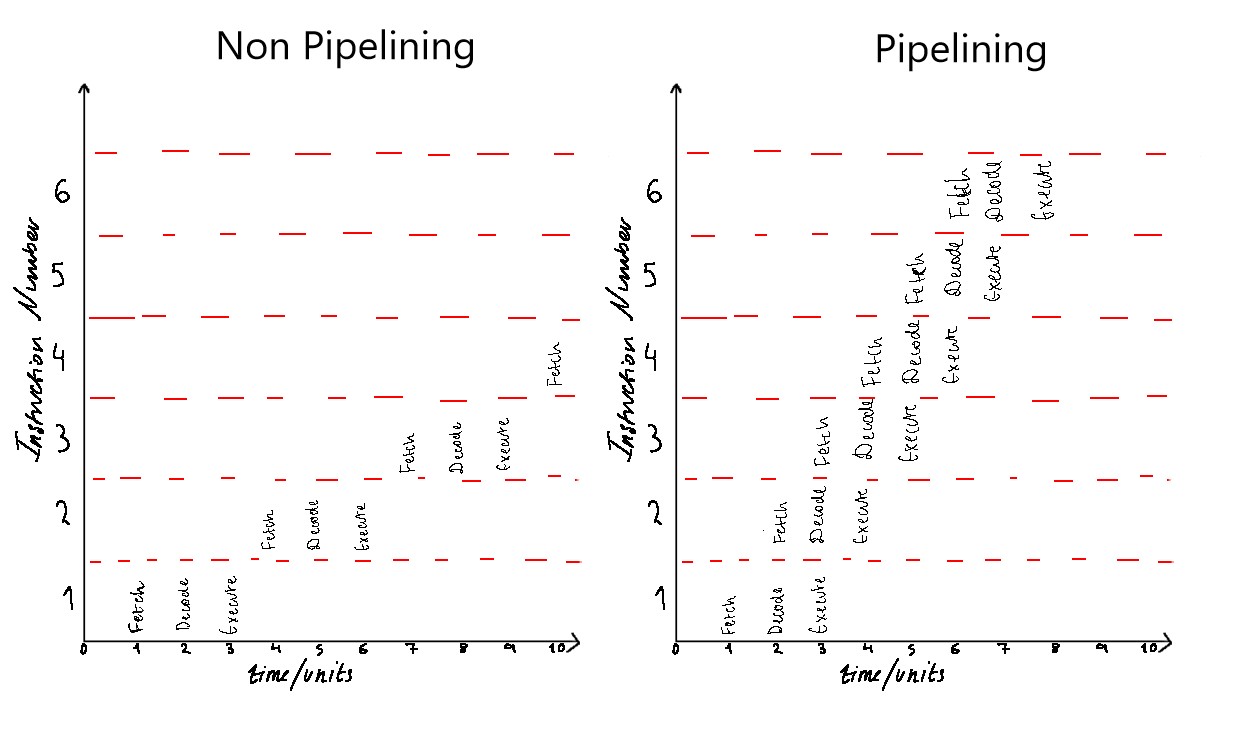
In pipelining, various components of the CPU can simultaneously conduct different stages of the Fetch-Decode-Execute cycle at the same time. For example, as the Program Counter increments by one to hold the address of the next instruction, an item of data can be copied from the MDR into the CIR to be decoded and exectuted. Overall, this boosts CPU performance as more FDE cycles can be run in a single second. This could be linked to content at GCSE where we looked at the "3 Cs" (clock speed, cache and number of cores) that also make a computer run faster overall. Whilst this idea of pipleining first developed in the 1950s, it was only implemeted into general purpose computer CPUs in the 1980s.
So we know that it improves CPU performance. It is a more efficient way of coordinating the CPU components and processing instructions.
But surely there must be some disadvantages?
And indeed there are.
1. : There may be an instruction that requires a value from a previous instruction that has not yet been completed. This means the program has to pause, taking longer time to be run.
2. : Stalls from any other factor can render pipelining pointless, especially when it has to wait for lots of other instructions to be completed first.
3. : If one stage takes a lot longer than the others, it effectively slows the entire model down.
4. : Pipelining means the CPU design is far more complex. There are more places in which errors can take place as the CPU needs to intricately synchronise everything.